Wednesday, 2 November 2011

WINOL Life - 1 November


I directed our second episode of WINOL Life and although I was very nervous I actually quite enjoyed it after. I made sure we did many, many rehearsals and we managed to pull it all together.

In total we had four cameras, when we usually only use two and we used lots of different shots. For a change we had the television in the middle of the couches and instead of rolling VT and going to VT straight from the link from the presenters. We rolled VT and had the presenters and our guest watch the television. We then went to VT about three or four seconds after it started rolling. I think that this looked very professional and made it a touch more like a real feature show.

This week we had Elizabeth Barnett in as our guest editor. She is actually editor of Hampshire Life. She was extremely nice and local too. She went to university at Solent and within six years of graduating she is now the editor. This makes me hopeful that I will be able to get a job when I leave and that if I work hard I can work my way up.

Elizabeth did a separate interview after WINOL Life giving us tips and telling us how she got the job. This was very helpful and actually showed me that it is possible for me to get published in magazines before I even leave university. Please find above the WINOL Life show and find the interview with Elizabeth on the Winchester Journalism YouTube page.

Law - 28 October

Peter Hodges was our guest lecturer this week. He was the Head of Rights at the BBC but is now independent. He covered copyright and fair dealing with us.

Copyright covers everything from music to film, from the performers to pictures and everything in-between. Copyright covers the object or person as soon as it is published. Showing a film you have made to a friend is not subject to copyright but once you have published it to the internet or put it on to a DVD for viewing this is then copyrighted. A DVD is subject to copyright for 50 years after it has been published and a book is out of copyright 70 years after the author dies.

We should have release forms and get any interviewee or performer to sign these. As well as anyone that may be in your shot. Only for educational reasons are you allowed to use copyrighted products but out of education everything has to be checked for usage. For example if you film a busker singing Lady Gaga you will need the buskers permission to show the filming and Lady Gaga's people's permission for her music.

If you want to use a book or extract from a book the author must give written consent.

We watched two films. An opera called La Traviata and a film called Conspiracy Theory. Watching these we had to pick up on everything that was copyrighted and so would need to be checked. From these we gathered that each individual actor, the music, the composers, the costume designers, the set people and sometimes even the lighting people are credited. Everything that you would normally look over is actually copyrighted and needs to be in the credits.

Fair dealing is when you are allowed to use a small amount of footage from a film, music video, game etc for free. As long as you credit the company and the person you are allowed to use this. Just make sure it is only a few seconds and no longer. A great example of fair dealing is in Ewan and Grahams game piece where they are reviewing games and have a small amount of footage from the games in the review.

Picture by: Mikeblogs

Monday, 31 October 2011

WINOL - 27 October

This was another week I produced and everyone on the production team honed their skills. It has been a couple of weeks and they now know everything in the gallery so they are now practicing on what they prefer to do. This meant that there should not have been any production problems. However we did have a small technical problem with the VT machine.

The package by Uldduz had no strap. It was great that we found this and managed to get a new package in within time but it was not put on to the video output machine properly and was not checked after being put on. So... when it came to playing it in the bulletin it did not work. This panicked everyone and did mess up the bulletin slightly but this was sorted in post production and the story was completely pulled out.

I also forgot to put the ending sequence on to the video output and so when it came to the end of the show everyone was a little confused and we simply faded to black. Again, this was sorted in post production. I want to keep this is mind for next week and not have any problems that need sorting in post production as this would not happen on a real news bulletin.

Headlines were recorded really well this week and we all now understand the new way of doing it. I prefer this way too as it is more like the way the news is done on ITN or BBC.

We recorded an in-studio talk with the graphic wall idea with Louis O'Brian. Last week we did it with Julie about the police exclusive and this week was about courses in universities dropping. This takes time to do and does push back our schedule but the more we do these the more prepared we will be and the quicker we will be able to get them done. I think that when reporters are doing these boards they just think oh I need a script for the auto cue and a graphic for the wall but they actually need much more. Tapes, timings between the graphic and their script and at least three scripts for everyone in the gallery to follow with are also needed. This all pushes us back when we do not have these things done and ready for filming.

Everyone did really well this week and despite the hick up with the package we recovered and carried on. Well done George for directing for the first time and Justina for presenting in English for her first time.

Tuesday, 25 October 2011

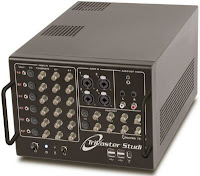
A Guide to... Setting up the Tricaster and the OB Kit

This is just something to refer back to as there are so many wires for each of them and it can get very confusing.

OB Kit:
For this you will need 1 x Black Cable
2x White Cable
1x Blue Cable
1x Audio box from the OB kit
1x Audio box
1x Orange extension lead
Talk Back, grey wire. In the front of the OB kit.
Microphone, in little black pouch.

1. "Audio Tie 1" links with the black cable to the microphone cable.
2. The left green wire from the cupboard links to one audio box. Then plug the headphones in to the same audio box.
3. The right green wire links with the blue cable and is plugged in to the second audio box. Plug the talk back in to this box too.
4. "Video to Studio" links with one of the white cables and goes in to the yellow hole on the camera.
5. "PGM Out" links with the other white cable and goes in to the TV box. You need to also plug this TV box in to the mains with the plug.
6. Make sure all the plugs are turned on around the cupboard. You may not always need the extension lead.
7. Turn the camera on and check the microphone and the talk back are working. You will now be fully connected with the studio.

Tricaster:
For this you will need 1x Tricaster
1x Tricaster screen
1x Internet cable
2x Plugs
1x Blue ended cable
1x Audio cable from the power tower in the gallery
1x Camera cable from the power tower in the gallery
1x Mouse linked to the tricaster through a USB lead.

1. Get all the wires out, the screen and the tricaster.
2. Plug in the tricaster and the screen with the power cables.
3. Link the screen and the tricaster together with the blue ended cable. One end goes in to the blue slot on the back of the screen and the other end goes on to the blue plug in slot at the bottom of the tricaster.
4. Plug in the Internet cable to the slot on the tricaster and to the wall in the studio.
5. From the Power tower get the camera cable and the two audio cables. Put the camera cable on to the "Y Composite" on the front of the tricaster and put the audio cable in to the top two slots on the front of the tricaster.
6. Turn the tricaster on at the back and the round button at the front of the tricaster.
7. No need to press ANYTHING else until it is fully loaded, and the gallery screen comes up.

To link the Tricaster to ustream to broadcast live or to record you need to go on to ustream.tv and login. You need to do this on another laptop. Do not do it on the tricaster and do not use the compter in the gallery because your recording from the tape deck will have the voices out of sync.

The login details are, username: WINCHESTERJOURNALISM
password: WINCHESTER1

All in capitals. Then click on the tricaster to record/stream. Click on ustream to stream and allow all options. Only click this just before you are ready to start recording or you will have a black screen for some times before your showing starts.

When saving this make sure you write something in every box as this is the only way it will save. You will then find it under, "my videos".

Good Luck.

Monday, 24 October 2011

Law - 20 October

This week we learnt more about Qualified Privilege. I mentioned the basics of this last week as a defence against defamation.

Qualified privilege is when what you have written has been said in court. If you are going to report something defamatory and plan on using qualified privilege as your defence you must report fast, accurately and fair. The offended person does not have to show that they have been harmed but do have to show that they have suffered.

Common Law Qualified Privilege is a form of the above but it does not have to be said in court. This can be used is the following conditions have been met. The public need to hear about it, this is something that you do not need to prove. It has to be without any malice at all. The article itself and EVERYTHING you have ever written before. You should never write with malice anyway but if you have any article with malice in, you can not use common law qualified privilege. Again, everything must be fast, accurate and fair; and, for good measure there must be reasonable suspicion.

Malice can expressed or implied. Either way is bad for journalism. No article you write should ever have malice in it. Unless you write comment pieces you should never have your own opinion in your articles anyway. When implying malice you are again, putting your own opinion in the piece which should not be done. To have common law qualified privilege you must show no malice and have no malice in any piece you have ever written/produced.

The Reynolds Defence

This is a list put together by Lord Nicholls that journalists must adhere to if they want to use the defence when publishing defamatory material. Bearing in mind that the piece in question is of public interest and is responsible journalism.

This defence came about when the Sunday Times was sued by Albert Reynolds; the former head of the Irish government. He sued because he believed that the story had deliberately and dishonestly misled the country's parliament.

In the defence of the Sunday Times they said that they were keeping within article 10 of the European Convention on Human Rights and that in public interest in political issues and the conduct of elected politicians should be protected by qualified privilege.

The Sunday Times lost but the following defence was put together to allow future publications to publish defamatory articles in the name of public interest.

1. The allegation must be true and the seriousness of the allegation.
2. The extent to which the information is a matter of public concern.
3. The source of the information. No one with previous anger against the accused or are being paid for the story.
4. All the steps that you've taken to verify the information. This must be recorded information.
5. The status of the information. If it is all ready subject to an investigation this must be respected.
6. The urgency of the matter. Can not be old news.
7. Approach the claimant for comment.
8. Whether the article contained the gist of the claimants side of the story.
9. The tone of the article. The newspaper can raise queries and investigations.
10. The circumstances of the publication, including timing.

This has been criticised as being too narrow by judges in the House of Lords.

For more information about the Reynolds VS The Sunday Times please visit, http://www.publications.parliament.uk/pa/ld199899/ldjudgmt/jd991028/rey01.htm

Research from McNae's essential law for journalists.
Picture from: Mail Online

WINOL - 19 October


This week went just as well as the week before. This week we had a lot more feedback from Angus and Brian as they took on roles themselves. Angus was the director and Brian was the news editor. This helped us by showing us what we should be doing and more information about the roles.

Julie had an exclusive story this week which came about from an FOI request. This enabled us to do something different in the studio this week. Julie did not have any pictures for this as it was about the police committing crimes themselves. So Julie and Chris made a graphic and we used it as an in-studio talk with a graphic wall. This took some planning as the graphics on the wall had to match up with what Julie was saying. This took a lot of rehearsals but finally we got it right and it came out looking great. The graphic could have been better and we need to have the edges of the graphic in another colour other than black because it does bring down the piece. It looks very dark and makes it harder for the presenter/reporter to stand out from the graphic.

We also filmed WINOL life this week which went amazingly. Justina managed to get a guest editor from the Daily Echo; Sally Churchward. She gave the features team some valuable feedback and we managed to put together a great show from it. This too took a few rehearsals but it all went to plan and looks fabulous. Everyone should be proud of the hard work they put in.

Including Sports Week we had nearly an hour of quality programming this week. We also had two guest editor, one for sport and one for the features programme. We did not have one for WINOL this week which made it possible for Angus and Brian to step in for a week.

Jack and I shared the role of producer this week so that he could learn more and it also enabled myself to learn more and focus on my skills as producer. Graham was on vision mixing, Dan was on sound and Ewan was on the autocue. We are quite a small production team but with help from features we are doing well. It also means that more second years are learning the production skills ready for when we leave.

In the gallery, the production team learnt a lot from Angus and how to direct. His directing also helped everyone in their individual roles as they received a lot more direction. Our normal directors do a great job but there is room to improve.

The packages are looking much better this week and there was actual competition throughout the day to get their packages shown as the news board was changing various times throughout the day. George, Ewan and myself made a package about the art exhibition at the university in only two hours on the wednesday. It was not used as it was too much like features but it gave all three of us good experience on reporting and reporting to a tight schedule.

As I was filming on the wednesday afternoon I was not in the studio. This meant that the Tricaster was not set up and so we were not able to stream it. Luckily we were still able to get it up live at 5 but we should definitely use the Tricaster every week as a back up.

Please find above the video for WINOL this week. Also find WINOL Life and Sports Week on YouTube on the winchester journalism page.

Law - 13 October

This week was libel and defamation.

You can commit libel if you do any of the following:
1. Defamation
2. Identification
3. Publication

Defamation is when you write an article that defames someone or a company. Defaming someone means you have damaged their reputation. To be accused of defaming someone it has to be proven. You can also be accused of defamation through slander.

Identification, this is when a particular person is named. This can be an accidental problem through jigsaw identification. This is when you tell the story with all the facts but you explain enough that the reader can understand who it is. Jigsaw identification can be done accidentally so when writing a script telling facts about the defendant you have to be careful you don't explain too much.

Publication is when the article/programme is viewed by more than one person. When published on the Internet each load of the page is another publication.

For each of these ways of defamation there are ways in which to defend yourself against it. You only need one of these defences but the more you have the more covered you are.

Justification is when what you have said is true and you can prove it. You need to be able to prove this though. This is one reason you should always keep all your rushes and notes. Especially if your notes are in short hand. This makes your evidence more believable.

Comment is your second defence against defamation. This is when it is the writers opinion. This has to be shown as definite opinion however. Many newspapers have a header at the top of the page saying comment or opinion. Sometimes guest editors also fall in to this category, especially in magazines where they get many celebrities to write a page of opinion on other celebrities, styles, fashion etc.

Qualified privilege is when what you have written has been said in court. If you are going to report something defamatory and plan on using qualified privilege as your defence you must report fast, accurately and fair. The offended person does not have to show that they have been harmed but do have to show that they have suffered.

Common Law Qualified Privilege is a form of the above but it does not have to be said in court. This can be used is the following conditions have been met. The public need to hear about it, this is something that you do not need to prove. It has to be without any malice at all. The article itself and EVERYTHING you have ever written before. You should never write with malice anyway but if you have any article with malice in, you can not use common law qualified privilege. Again, everything must be fast, accurate and fair; and, for good measure there must be reasonable suspicion.

Picture By: Mr T in DC